Saturday, September 15, 2007

Customer equity to drive your marketing ROI


During my Lotus years, I've been given the opportunity to meet Mike Zisman our CEO at the time. One of his statement stayed with me since then: "The purpose of any enterprise is to acquire new customers and retain existing ones. Product an services are only a means to that end." It sounded a bit simplistic initially, but my experience in several companies since then reinforced my conviction of the importance and truthfulness of this statement.

During my marketing journey, I discovered the notion of customer lifetime value (CLV), more complex to comprehend and so effective to coin what your marketing focus should be and furthermore how to present it to your team. It also allows to present to CEOs and shareholders the real value ($) of customer loyalty.

Here comes customer equity that definitely coins the term that best represent all of this. You now can think of CLV as an an additional equity to the shareholders or the brand ones.What if you could revise Marketing ROI and fine tune your marketing course of actions based on this equation coming from Roland T. Rust in Advertising Age : "The ROI is simply calculated as the projected increase in customer equity minus the discounted [marketing] investment divided by the investment."

But how do you calculate customer equity with real numbers? Now we're talking ;-)
Well, a number of tangible and intangible enters into this and I do not necessary agree with Roland Trust in his article. I'd refer you to Customer Equity Calculations dedicated site, and will come back on this later on. To approach it, just think of customer equity as the total of the discounted lifetime value of all of its customers. I know, not that intuitive.


To be continued ...

Sunday, September 02, 2007

Enterprise 2.0 is here to stay


Fellow marketers, I've been away for quite some time, focusing on some quality time without a computer (can you believe that?). I'm back, energized and ready to roll!

I wanted to open it up to a new topic, here on Marketing 2.0, that is keeping my team busy for quite some time now: Enterprise 2.0.

I'm sure you heard the buzz word before and maybe took a more in depth look at it. But I guess for those working in the IT industry and already involved in the Web 2.0 phenomena it's the natural question to ask ourselves: what are the Web 2.0 attributes, social behaviors and underpinning technologies bringing to the enterprise? Is this only about taking blogs, wikis, RSS feeds and what have you, to your intranet? Or is it a more profound paradigm shift that will finally unleash the expected new enterprise species of the new millennium?

You bet some of our gurus have been writing and pitching about it as the yearly Enterprise 2.0 conference can attest. Let's hear some of the most visible. First of all, spend about 10mn to view this introductory video on ZDNet Web 2.0 for the enterprise.
You can then take the direct and simple view of Andrew McAfee's Enterprise 2.0 definition:
"Enterprise 2.0 is the use of emergent social software platforms within companies, or between companies and their partners or customers."
Of course what Andrew develops beyond that definition is more complex but is basically centered around a new stage in knowledge management. But I am more in sync with Don Tapscott's views about it. If you did not read at least one of Don's best sellers, I encourage to start with Wikinomics. To give you a feel for it:
"The rise of pervasive, networked IT is fostering new business strategies and designs that enable firms to create differentiated value, lower cost structures and therefore increase their competitive advantage. A new model of the firm is emerging – the Enterprise 2.0. Firms that embrace this model succeed and compete well. Those that do not decline."
If you're now thrilled and ready to spend 40mn or so, listen to Don's pitch at the Enteprise 2.0 conference. It's fun and enlightening.
Finally, and to close this first post about Enterprise 2.0, I found Fred Cavazza's in depth post What is Enterprise 2.0? about it very useful to provide a solid 360 view.
Stay tuned for more, Enterprise 2.0 is here to stay.

Saturday, July 28, 2007

User-generated content spans interest across generations


User-generated content and other web 2.0 trends, one would think, are mostly driven by teenagers and young adults. On the contrary. Here is an interesting research lead by Harrison Group (an independent research services firm) conducted from February through March 2007, showing that both the old and young generations enjoy reading magazines and are receptive to print ads. Additionally 51% of U.S. consumers are interested in watching and reading user-generated contents.
Harrison Group categorizes them as young Millennials (ages 13 to 24), Generation X (25 to 41), Baby Boomers (42 to 60) and older Matures (61 to 75). Here are some of the findings (read more on Deloitte site and Are you ready for the future of media? ):

High Demand for User-Generated Content
  • 40 percent of all survey respondents are making their own entertainment (editing movies, music and photos)
    • 25 percent of Matures
    • 56 percent of all Millennials; leading Millennials (18-24) participate more
  • More than one in 10 Millennials are actively uploading their own videos on the Internet
  • 51 percent of all survey respondents are watching/reading content created by others
  • 71 percent of Millennials, 56 percent of Xers; Boomers/Mature participation is less, but noteworthy
  • 53 percent of Millennials would download more videos if connection speeds were faster
  • One-third of online content viewing is done on user-generated sites
    • Almost ¼ for Matures, ½ for Millennials
This reinforces our belief that user-generated content is expanding its impact on several industries as media, software, music, videos, TV, ... Stay tuned for more.

By the way, let's celebrate our first Marketing 2.0 birthday. It's been already a year since I started my English-French blog about Marketing in the web 2.0 era. Thanks to you this blog is spanning its influence in many countries and I enjoy many more subscribers every day. Keep it growing. Thanks to you all.

Monday, July 23, 2007

Who needs a PC? HP acquires Neoware for its thin Linux client technology


Intelligence seems to take place on the network these days. What about this amazing breaking news of HP acquiring Neoware for $16.25 per share i.e. $214 million announced today. Check out the news.
It strikes me as HP is the leading vendor in PCs and yet they place their bet on a thin client, but a Linux one, as they want to take advantage of virtualization technology. But pay attention to this: Neoware is the third-largest thin client vendor, after Wyse and HP. Wow, if this is not a big bet on the webtop, I should just change job and move to the pharmaceutical industry.

More importantly, it seems that HP was attracted by the mobile thin client computing paradigm as Linuxdevice.com reports:
"During the past year, Neoware has claimed a couple of "firsts" in thin client computing. Its m100 thin client notebook, introduced last October, was touted as the first device aimed at extending the security benefits of network computing to mobile workers. And, in March, it announced a new VDI Edition family of thin clients aimed at virtualized client computing systems. These clients appear to have been instrumental in convincing HP to acquire the company. "

Who still needs a PC?


Learn more about thin client computing, virtualization on wikipedia and listen to this podcast about state of virtualization on eweek.

Thursday, June 28, 2007

Online surpasses radio ads, user-generated content sites make more than $1.6 billion


It's been a while since we didn't bend back on numbers. Here are some good news on the online ad spend for 2007, coming from emarketer.com, that I wanted to share with you. If you don't want to read it all, here is a quick summary:
  • eMarketer is raising its 2007 forecast from $19.5 billion to $21.7 billion i.e. from 18.9% to 28.6% growth closer to the 30% growth seen for the last 3 years
  • they even see 2008 stronger with 30% growth to a total $28.8 billion, thanks to the US presidential elections
  • 2009 will slow down a bit to 18.1%,
but hey they've been pessimistic for 2007 so let's wait and see. Here is the quote I like most:
" Online advertising as a share of the total media budget will surpass radio this year, eMarketer said, and top 10% next year." -- Advertising Age, June 2007

Come on, one last to hit the road: WW user-generated content sites will earn $1.6 billion in ad revenue for 2007 moving to $8.2 billion in 2011, predicts eMarketer. Marketing 2.0 finally makes money, isn't it?


Saturday, June 23, 2007

We're moving from Desktop to Webtop


"Microsoft and IBM executives Wednesday admitted feeling heat from Google now that the Web search giant is trying to make inroads into the enterprise market with its hosted suite of communication and collaboration tools." says NetworkWorld.

Desktop productivity suites -- i.e. Microsoft and Open Office -- are beginning to appear as legacy apps for younger internet user generation. If you think about it, up to a few years ago, our desktop was application centric. You'd have to think about what application to use to either create, edit or read information. In this antic time, still valid for conservative users, Office was the place where we'd live on our desktop. Not anymore for Internet centric users, especially 15-24 years old.

Multimedia content, supported with the advent and success of Youtube, flickr, slide.com, and others not to forget podcasts, is paving the way to another information form factor. As a matter of fact, information streams to you via RSS feeds sitting on your desktop via Netvibes personal portal on the web and various widgets. Google apps are starting to give a clear headway towards SaaS collaborative "desktop" productivity applications, not to mention they've just completed another step in completeness with Tonic acquisition -- a presentation sharing and collaboration solution for Powerpoint slides.

To sum it up, I believe we've moved from Desktop to Webtop with several key implication:
  • Our digital environment is no more sitting on our PC but on the network,
  • Our environment is no longer application centric but user centric i.e. information is flowing your way whatever the application required to exploit it should be. Various alerts are pacing your information day from blogs, information sites, our mailbox and calendar,
  • Users are empowered to design their environment, not software vendors!
Webtop is a personalized web hosted desktop that you can use everywhere, from any device, that no software vendor would design for you. This is pure Web 2.0 attitude: users are designing their webtop "app" aggregating various components in an iterative and collaborative way -- users recommend widgets and apps to others. Gone the day when software vendors were dictating their view of the world. Folks, we're in charge again. And webtop already have vendors, check out Goowy.

Microsoft colleagues, can you feel the heat?

Thursday, June 14, 2007

Widgets reach 21% of the WW internet audience n April


Just a very quick one fellow marketers, I found out this number on AdvertisingAge and could not resist but share it with you. Widgets reached about 21% of the worldwide internet audience in April, ComScore -- who started to track widgets usage accross the web -- found. About 40% of widget use, or 81 million of those people, came from North America. Slide.com (a cool slide sharing site) had the largest reach, followed by RockYou, Picturetrail and Photobucket, all photo sharing sites.

ComScore defines widgets as shockwave data files embedded into a site's HTML code.

"The reach that widgets have is going to surprise a lot of people," said Max Levchin, founder and CEO of Slide. "What advertisers are ultimately interested in is what are people looking at, not what page."

Widget advertising! So coool.

Sunday, June 03, 2007

Google Gears: last mile to a 100% web based application world?


In a meeting recently, in my new job at Sage, we were discussing with R&D about the client model in our new world. Interesting debate among specialists that are seeing the world through RIA (Rich Internet Application), RDA (Rich Desktop Application) and the fading 100% HTML or client/server models. It clearly shows we've been moving fast in a connected world were web based applications are weaving into desktop based applications.

Tectonic moves are taking place between Microsoft, with the Silverlight new cross-platform and cross-browser Internet platform, Adobe's Apollo run-time and the newly announced Google Gears Javascript API to let web applications work off-line. Read Information Week Why Google Gears Is Good News, Bad News For Microsoft article for a better understanding of the landscape and browse through the 92 news articles about it.

But now the non connected world enters web based applications and the very last argument pleading for desktop based applications is just going away, even before being connected to the Internet will be as natural as receiving daylight (a bit futuristic I must admit, but you know me by now I like to provoke). Give it a try and install it. Are you as curious as I am to see what the next Google/Microsoft battle is going to be?

One thing for sure: user's information environment is already partly on the web and on his desktop. I'm not a big fan of this as users need to decide before searching or operating where the information might be or be sure they carry a laptop with them at all times. My bet is user's information are going to move 100% on the web with a solid secure access and backup. The device we will be using to access and manipulate this data is secondary and might just be borrowed when we need it.

Tuesday, May 22, 2007

Microsoft finally strikes back


Even on holidays, I could not escape the news: Microsoft finally made its mind on how to enter the $125 billion Advertising Market, they acquired aQuantive on May 18th for $6 billion.

Interestingly enough, not only do they acquire one of the most powerful web media buyer but they also acquire web design services through its Avenue A/Razorfish division.

One thing is sure, as I was wondering after Google's DoubleClick acquisition in "Would you have Google as your middleman", Microsoft had an answer to the Internet titan move. Sad news for web ad agencies, competition and battleground have changed in your world within a few weeks (see chart). Read this Microsoft Storms Madison Avenue article in AdvertisingAge for more on the earthquake.


But folks, let me enjoy my vacation fully, I'll be back in June.

Saturday, April 28, 2007

Would you have Google as your middle man?


First of all thanks to those of you asking me to write more often, much appreciated. One of the reason I didn't write too much recently lies in the fact that I started to work in a new company and I'm overwhelmed with new information to absorb and categorize. I wish I had a Wiki built in my brain, so everyone could contribute. But that would be brain 2.0 isn't it?

So fellow marketers, I'll be getting back to a better post frequency as soon as possible and of course I'll let you know rapidly what company decided to have me on board. The one thing I can tell you at this point is that I'm back to the Enterprise Application Software gang. It's going to rock there and I'll be writing about it in the near future.

I just wanted to drive your attention to this interesting joint Intel and Google announcement I read in Advertising Age: Intel, Google Join Forces for 'Virtual Marketing Storefront'. Let's get rid of the bells and whistles, Intel is agreeing to have Google as the middle man to manage partners co-marketing on-line (at least for on-line advertising for now). Strange move isn't it, and I don't buy it. If one vendor is serious about his ecosystem, one needs to manage it and not leave this to third parties having a biased interest that might hurt the vendor's strategy.
I don't have anything against Google, and I should say I praise them to have vigorously made Web 2.0 strong, but I would not let Google be my middle-man, instead I'd have Google be my ecosystem provider. Not to mention that Intel's partners would probably benefit from an integrated approach to their co-marketing experience with Intel. On-line advertising is far from being enough.

Apart from this, if you didn't notice Google's accelerated pace to expand their business footprint, here is a quote that says it all:
"This month alone, the company has announced its intent to acquire ad-placement giant DoubleClick; struck a deal with Clear Channel Radio to sell ads on its radio stations; added support from several major radio-station systems for its Google AdSense for Audio program; and partnered with EchoStar to sell TV commercials over the satellite broadcaster's Dish Network. " -- Beth Snyder Bulik, Advertising Age
Hey fellows at Microsoft, it's about time for you to react to try to grab some of the $125 billion advertising market Steve Ballmer claimed he was after.

Wednesday, April 18, 2007

What business are we in: Software or advertising? Google latest news

I just couldn't help but coming back on Google (GOOG) latest news, accelerating innovation and dominance -- read Google expands office software for more on businessweek.com -- attacking both Yahoo and Microsoft at the same time :

"Google announced Friday it would pay $3.1 billion to acquire ad-management technology company DoubleClick Inc....Google announced the acquisition Tuesday of Tonic Systems Inc., a startup based in San Francisco and Melbourne, Australia. The company specializes in collaborative presentation software and is expected to contribute to future versions to Google's productivity suite." -- businessweek.com

This InformationWeek Google's Deal For DoubleClick Could Be The End Of Yahoo article emphasizes the advertising acquisition even more, and finally here is what reported on earthtimes.org about the Google Clear Channel deal:

"Google Inc. and broadcaster Clear Channel Communications Inc. have signed a multi-year advertising sales agreement under which Google will start selling its advertising on radio stations, thereby making its entry into what is described as offline media -- radio, TV and even print publications."

If you didn't realize that Google is clearly moving on two fronts at the same time, SaaS dominance together with entering end-to-end advertising via the on-line door, you've just been living on an island without any kind of media access since January! No later than today, MediaDailyNews reports about how the ad industry major players are reacting about it: Google Looms Over Ad Research Summit, Seen More As Friend Than Enemy.

What business are we in folks? Software or advertising ... it may be both.

Wednesday, April 11, 2007

State of the Blogosphere


The blogosphere is just expanding like crazy. But you might wonder: what are the numbers? Thanks to Technorati, delivering numbers on a quarterly basis, here are the latest trends released and commented by Dave Sifry in his post The State of the Live Web last week:
  • 70 million blogs are currently tracked
  • About 120,000 new blogs are created each day, or...1.4 new blogs every second
  • 3000-7000 new splogs (fake, or spam blogs) created every day
  • Peak of 11,000 splogs per day last December
  • 1.5 million posts per day, or...17 posts per second
  • Growing from 35 to 75 million blogs took 320 days
  • Japanese the #1 blogging language at 37%, English second at 33%, Chinese third at 8%, Italian fourth at 3%, Farsi a newcomer in the top 10 at 1%
  • English the most even in postings around-the-clock
One quote gives you a feel for whether blogs are a fad or here to stay:
"Since our last State of the Blogosphere report in October 2006, we’ve seen a slowing in the doubling of the size of the blogosphere. This shouldn't be surprising, as we're dealing with the law of large numbers - it takes a lot more growth to double from 35 million blogs to 70 million (which took about 320 days) than when it doubled from 5 million to 10 million blogs (which took about 180 days)." -- Dave Sifry
Interesting as well is the popularity of blogs compared with traditional or media websites. During Q3 2006 there were only 12 blogs in the Top 100 most popular sites, in Q4 this is rising to 22. Even more, the audience tends to distinguish less and less blogs from official media sites as NYTimes and considers blogs as news providers. Is this the rise of Press 2.0?

Enjoy and spread the numbers out there. Blogs should be part of your Marketing 2.0 dashboard.

Monday, April 02, 2007

WOMM: Marketing 2.0 lethal weapon


One of the most critical dimension of Marketing 2.0 lies in Word of Mouth Marketing (WOMM). As defined in wikipedia:
"it is a term used in the marketing and advertising industry to describe activities that companies undertake to generate personal recommendations as well as referrals for brand names, products and services."
WOMM in my opinion was first identified by Regis McKenna when describing the market infrastructure in his aging book The Regis Touch. WOMM now has its association Word of Mouth Marketing Association and his guru Word Of Mouth Marketing: How Smart Companies Get People Talking - Andy Sernovitz. As Andy puts it, here is his WOMM Manifesto:
"1. Happy customers are your best advertising. Make people happy.
2. Marketing is easy: Earn the respect and recommendation of your
customers. They will do your marketing for you, for free.
3. Ethics and good service come first.
4. UR the UE: You are the user experience (not what your ads say you are).
5. Negative word of mouth is an opportunity. Listen and learn.
6. People are already talking. Your only option is to join the conversation.
7. Be interesting or be invisible.
8. If it’s not worth talking about, it’s not worth doing.
9. Make the story of your company a good one.
10. It is more fun to work at a company that people want to talk about.
11. Use the power of word of mouth to make business treat people better.
12. Honest marketing makes more money." -- Andy Sernovitz
Let's make sure you've got a WOMM plan embedded in your coming PR activities. It is cheap, mostly effective, but terribly difficult to ramp up. Who are the individuals you're targeting? How do you approach them without sounding too much biased? How do you recognize them? With what stories and messages do you nurture them? All these questions need to be addressed prior initiating your WOMM as WOMM is Marketing 2.0 lethal weapon.

- Image courtesy of The influencers at www.theinfluencers.ca

Friday, March 23, 2007

Let's support sales performance


Several years ago I discovered Sergio Zyman in Paris when he was conferencing for his new book "The end of marketing as we know it". He's not bringing some rocket science to marketing but effectively highlights and helps us focus on the do's and don't of an effective marketing. As a matter of fact, he left me with this quote that I keep in mind at all times:
"The sole purpose of Marketing is to sell more to more people, more often and for more money." -- Sergio Zyman

In light of this quote, I'm always focused on filling the gap between sales and marketing, making sure sales reps are perceiving added value from marketing activities. If you do not enjoy good business relationship with your sales counterpart, start asking yourself what is to be changed in your deliverables. Marketing success is about increasing revenue and lowering cost of sales. Whether in Marketing 1.0 or Marketing 2.0 it makes no difference.

I'm bringing this up as I recently read some interesting numbers about Sales performance Benchmarks, and I wanted to share with you the striking ones out of this survey from 1,300 companies across all industries:
  • Only 60% of sales reps are making or exceeding quotas.
  • Only 37% of firms report they have implemented a formal sales process.
  • 63% of revenue comes from existing business, while 37% comes from new business
  • Only 38% of companies have what they would call "forecasting accuracy."
  • Most have close rates of under 50% of proposals written (average=48%).
This Lewis Green post says it all:
"For at the end of the day, our bottom lines and the value of what we do are measured in sales, not direct mail campaigns, sell sheets or packaging....I also believe that sales and marketing staffs should be in one department and should work closely together on every step of the process, from understanding the customers, to strategic marketing and sales planning, to closing sales" -- Lewis Green
Fellow Marketers, we're in charge on this. Let's make it happen.

Friday, March 16, 2007

Market segmentation to increase attitudinal loyalty


I mentioned behavioral targeting recently on Marketing 2.0 as a way to increase marketing effectiveness. I wanted to come back on this topic in light of a datasheet that you can download from Omniture, to share with you a tip about successful segmentation as described in Wikipedia.

"The requirements for successful segmentation are: homogeneity within the segment, heterogeneity between segments, segments are measurable and identifiable, segments are accessible and actionable, segment is large enough to be profitable.
These criteria can be summarized by the word ADAMS:
  • A Actionable: you must have a product for this segment
  • D Differential: it must respond differently to a different marketing mix
  • A Accessible: it must be possible to reach it efficiently
  • M Measurable: size and purchasing power can be measured
  • S Substantial: the segment has to be large and profitable enough" -- Wikipedia
I won't come back on all segmentation variables (Geographic, Demographic, Psychographic and Behavioral), you can follow the links for more, but I wanted to highlight the behavioral ones: benefit sought, product usage rate, brand loyalty, product end use, readiness-to-buy stage, decision making unit as Wikipedia refers to it in the Marketing 1.0 world. This is still valid of course, but new dimensions do appear with Marketing 2.0 especially around behavioral analysis. Thanks to web techniques you can easily track, using cookies for instance, what a prospect did before landing on your web site and what retained their attention.

More interesting, in our web 2.0 world, is the way a prospect, or for that matter, a customer expresses his relationship to your brand. This has changed significantly with the web 2.0 advent. As a matter of fact, behavioral targeting and market segmentation offers a powerful way to dialog differently with each segment. Defining your segments along the lines of attitudinal loyalty -- more on customer loyalty on wikipedia -- and remembering ADAMS rules will guide you to the appropriate solution to improve it.

Friday, March 09, 2007

Web 2.0 goes mobile: 2.7 Billion phones out there


As I was looking for some numbers to support my yesterday's post, I found this very interesting one Communities Dominate Brands: Putting 2.7 billion in context: Mobile phone users, from authors of this Communities Dominate Brands book I didn't read yet, providing interesting metrics to think about:
"800 million cars, 850 million personal computers, 1.3 B fixed land line phones, 1.4 billion credit cards, 1.5 billion TV sets. How many mobile phones in use today? In use today, yes, 2.7 billion. They sold 950 million phones last year and the total worldwide mobile subscriber base grew from 2.1 billion to 2.7 billion. Three times as many mobile phones as automobiles or personal computers. About twice as many mobile phone owners as those of fixed land line phones or credit cards. And almost twice as many mobile phones in use as TV sets." -- Let's draw a rapid conclusion here, mobile phones or more widely Mobile devices will have the next big impact on the web as carriers evolve their business model for Internet access to a flat monthly fee as for broadband. The next massive disruption on the net is already happening: Web 2.0 goes mobile. Consumers will voice their opinion, pictures and videos to share visual news taking place close to them directly from their phones!

Tell me fellow marketers, would you ignore this bidirectional medium when you know Marketing 2.0 is already here? What a big bet!


Thursday, March 08, 2007

Mobile Marketing: use it carefully, but use it


I was attending Ad Tech Paris yesterday, a good way to capture on-line advertising trends. Among other interesting sessions, I was appealed by the mobile advertising one called "Mobile advertising – the long and winding road" coordinated by the Mobile Entertainment Forum (MEF). Speakers, see picture from left to right, were Marc-Henri Magdelenat -- Screentonic, Minh Tran -- Nokia Mobile Advertising, Patrick Parodi -- Amobee & MEF, Richard Saggers -- Vodafone and our moderator Gilles Babinet -- Eyeka.

They covered a lot of ground to explain how important was mobile advertising among our marketing tactics and how unique was its approach. Not to forget for instance that permission marketing in this space is mandatory, nothing is more personal than your phone, right? Mobile Phones are the only new device that people carry all the time since watches were introduced. Some do even sleep with these! Keep in mind as well that consumers are actually paying to receive adverts so we should keep ads short and relevant. And finally, coupons on mobile phones -- yes, bar codes on your phone to present to the store you're in or close to -- are far easier to use for consumers than traditional ones or even web ones, especially when coupled with your location.

Having experienced the mobile industry at Sun Microsystems myself, when marketing the Java platform, I could not agree more to the effectiveness of mobile marketing. Europe and Asia are for sure ahead of the curve about it, as mobile devices connected to the Internet are spreading fast there. The UK even have a dedicated web-zine about it called Mobile Marketing Magazine. Amazing!

But I think some key aspects were eluded during the conference. Mobile phones do have key attributes that can nurture marketing ROI:
  • Authentication: we know who you are for sure,
  • Payment: your Telco provider can charge you for what you buy or consume with it, opening an opportunity for Telcos to become trusted party for e-commerce,
  • Impulse and web 2.0: as you carry your phone with you all the time, nothing would be more natural than to use it for an impulsive buying decision and to channel back your opinion to the brand right away.
Not to mention that within the next 3 to 5 years, mobile devices will become the primary Internet access for consumers, as Japan experienced already. The user experience will significantly improve as well, check the iPhone introduction by Steve jobs here in Marketing 2.0 to get a feel for it.

Marketing 2.0 minded marketers cannot ignore mobile marketing when planning for the next campaign. Consider it for sure in your mix, but very carefully as this could be a double edge sword.

Tuesday, February 27, 2007

iPhone launch: rehearse what product introduction should be


iPhone is out for Oscars. If you didn't get a chance to see the movie on Apple homepage, have a look it here on Marketing 2.0 from YouTube.
This movie -- created by TBWA Media Arts Lab, Los Angeles (a unit of longtime Apple shop TBWA/Chiat/Day) -- has been screened 3 times during the Oscar broadcast and marks the first time since long that Apple advertises for a not yet available product. It is a clear indication that the buzz is going to get huge.

Steve Jobs previewed the iPhone during the MacWorld conference, early January in San Francisco - watch his Keynote address and rehearse again how product introduction should be done even when the product is not yet around ;-) . As usual, Apple demonstrates its ability to redefine an entire market by setting the bar about design and usability. Stay tuned, I'm convinced the iPhone is going to be a big hit if priced properly.

Tuesday, February 13, 2007

More than 1Billion Internet users WW


This is the kind of data you often need but do not have at hand. Internet users, defined here as someone who uses the Internet at least once per month, reached 1 Billion individuals in 2006 according to the ITU i.e. 17% of the world population.

The US is still the leading market but China will probably take the lead before the end of the decade says eMarketer. South Korea has the most important penetration ratio with 70.5% of its population already Internet users. In Europe Germany is the widest market with 39.4M Internet users. Take a look at the chart above for more details.

Morgan Stanley in The State of the Internet, Part III forecasts interesting demographics and behaviors that we should integrate in our Marketing 2.0 plans:
  • "The Internet continues to go global
  • Online video is gaining momentum
  • User-generated content properties have moved to the top of the pack, owing to their focus on community and personalization
  • Longer term, monetization should grow faster than usage, which should grow faster than users. Global Internet thesis calls for 10-15% user growth, 20-30% usage growth, and 30%+ monetization growth." -- Morgan Stanley
Don't worry fellow e-marketers, our business can only grow!

Saturday, February 10, 2007

My Sun's journey is over: Marketing 2.0 can be on your side


31 January was my last day at Sun Microsystems Inc. After a passionate and exciting 4 years journey I'm now headed to new ventures. As many Sun alumni, I miss the people more than anything else.
What stroke me when I joined back in 2003 was the Sun's bold approach to IT. "The network is the computer" tag line was not just a marketing gimmick, but a genuine belief aimed at changing the way the world would see and appropriate computing forever. The Internet bubble left Sun in a bad shape with a 50% revenue decrease at that time, but the dot com spirit was still there because it was more than just a business opportunity, it was a raison d'etre.
This way of living digital got in my face when I first joined an internal meeting. I saw executives just sliding their employee badge in a Sun Ray, a thin client device, retrieving instantly their environment and the slides they were about to present though miles away from their usual office. Where is their laptop was I thinking to myself? What a strange crowd! Network Computing was a reality and it works great fellow marketers.

I experienced many times Scott McNeally's ability, Sun's CEO at that time, to make unconventional assertion without shaking and against everyone else opinion -- that he used to call "conventional wisdom" with despise. What is amazing is that he was very often right. Scott demonstrated a true inspiring leadership during tough years at Sun. Innovation, humor, and resilience were his attributes. He was easy to access to when present on Sun's campus. Simply human but so smart.

Jonathan Schwartz took over in May 2006. A very bright executive, very passionate. As Sun is achieving its turnaround, Jonathan will have to face a tremendous challenge. He's more than up to it, he can succeed glamorously. Just one recommendation Jonathan, if I may. Don't loose sight of Sun's human capital. I did witness several talented people leaving Sun despite their willingness to stay. It is sad and sends the wrong message. Sun used to be a very good company to work for and attracted the brightest contributors. Good luck to you and good luck to Sun and my ex-colleagues.

As a matter of fact, I get back my freedom of speech and I'm now able to comment on Sun's strategy independently. I'll use that. This also set me free to engage with you if you need some help in your projects. Marketing 2.0 can be on your side.

Monday, February 05, 2007

Michael Dell returns as the CEO: the shake-up is on its way


I've been commenting and highlighting for some time what was appearing to happen at Dell -- you can read all Dell related posts on Marketing 2.0. Dell customers should be glad to see Michael Dell return as the CEO of the company he created and by the way investors as well. Why? Mainly because Michael Dell has always been focused on customers satisfaction.
Let's take a close look in the coming weeks to the concrete changes Michael Dell will initiate to turn things around. To begin with his recent e-mail to Dell employees already indicates that he will attack bureaucracy and develop its global services business.

I would repeat my recommendation, in a pure Marketing 2.0 inspiration:
"Appoint a Marketing 2.0 executive that you'd call Chief Voice of Customers Officer, with Web 2.0 as the only authorized marketing media. Engage the customer community in a genuine, transparent and honest 2 way conversation with your brand."
Of course this is not to be considered as the only thing to be done, but one that could not be forgotten. Customer loyalty is key to any business growth and trust is key to customer loyalty. Trust nowadays demands transparency and genuine customer centric business state of mind. Good luck Michael.

Wednesday, January 24, 2007

Increase Marketing effectiveness: use behavioral targeting


It's been around for quite a while, the late 90's. But as privacy and technical issues are going away, marketers should consider behavioral targeting in their on-line advertising campaigns.

For those who just missed it, behavioral targeting is the ability to deliver ads to consumers based upon their recent behavior viewing web pages, shopping online for products and services, typing keywords into a search engine or a combination of all three. You can have some more details on behavioraltargeting.com and behavioral targeting 101 on iMedia Connection.

Microsoft recently added it to its offering -- read Microsoft adds behavioral targeting - Tech News & Reviews - MSNBC.com -- as Yahoo did before as well -- read Yahoo! behavioral targeting.

Interestingly enough, AdAge Digital highlights that Behavioral Targeting becomes The New Killer App for Research. Some even put forward some effectiveness performance:

"The behavioral targeting ads increased ad awareness by 51%, while content targeting resulted in only a 33% boost." -- Snapple

As Marketing 2.0 is all about considering your customers and prospects literally as Stars, this should be no surprise to you that I wanted to stress the use of it as a "must have" advertising tactic. Relevant context is king.

Monday, January 15, 2007

e-commerce revenue over $100 Billion!


Wow! This is a confirmation that e-commerce is now for real and significantly impacts the retail industry. The overall traditional retail business in the US just grew between 2.5% and 3.5% during the 2006 holiday season according to analysts. To be compared with the 26% growth for the retail e-commerce in Nov/Dec 2006 according to comScore Networks (see emarketer.com chart and E-Commerce Hits All-Time High in 2006 ). Daily scores averaged $600M A DAY, with a peak at $667M on December 13 according to comScore, to be compared with the $556M peak in 2005.

For the full year, 2006 online retail spending reached $102 billion, a 25% increase on 2005. Don't ask if Marketing 2.0 needs to deal with e-commerce returns, just make sure your e-commerce web site and entire back office organization is up and running.

Read more about e-commerce in Marketing 2.0.

Friday, January 05, 2007

Internet creation festival


I wanted to highlight a close friend initiative, Christophe Ginisty. He passionately organises an Internet creation festival: Le festival de Romans.

Go ahead, at least on the net, and vote! (you need to read french a bit though ;-) )

I'll let Christophe tell us why:

This event aims to celebrate creativity at a time where the masses can access the Internet. Our goal: demonstrate that the web did set creation free and let an entire new artists generation arise.

Happy new year 2007


On my way for a new venture,
I wanted to wish you a wonderful
and exciting new year.

"Whatever the public blames you for;
cultivate it, it is yourself" -- Jean Cocteau


Thursday, December 28, 2006

2006 trend: capitalizing on customer insights


It is the right time of the year to take a look back at what we thought were going to be the trends for this ending year. McKinsey is doing it in a number of areas -- read Ten trends to watch in 2006 for all of it -- but one of them caught my attention as we discussed it many times in Marketing 2.0 -- check User Generated Content label and on Marketing 2.0.

Capitalizing on customer insights is probably the one dimension that gave Marketing in the web 2.0 era, a.k.a. Marketing 2.0, a clear paradigm shift. Read McKinsey Capitalizing on customer insights article about it. As McKinsey points out, we need to embed customer insights in the organization's key decisions from sales planning to marketing investment. It cannot remain anymore an isolated research belonging to a specific division within our marketing department.

When considering on-line marketing and customer engagement, it even becomes a real-time discipline. Yes, Marketing 2.0 is to be managed real-time, leading to a real-time business adaptation. No need here to even remind you about these newly created companies betting their full business model on this user generated content (Flickr, YouTube, ...).

Capitalizing on customer insights is no longer "nice to have" but clearly moved in the "must have" category for all of our businesses.

Monday, December 18, 2006

Integrate an end-to-end viral marketing to your Marketing 2.0 plan


Viral Marketing is an integral part of Marketing 2.0. Thus agencies are starting to exploit the lack of integrated tools and strategies for you to have a full viral marketing set of tactics embedded in your campaigns. Here are some of the available ones I noticed:
Some marketers have a tendency to think that viral marketing is just about creating an e-mail buzz or post a funny video on YouTube. DON'T! Viral marketing is more than just one isolated tactic or a trendy gimmick to sparkle on your existing plan. It is an entire dimension to your on-going marketing strategy.

The difficult part of it is to address influencers as a demographic target. In fact influencers usually aren't. As Regis McKenna coined it many years ago, in his famous book The Regis Touch - 1985, influencers include all individuals between the vendor and its prospect impacting the decision to buy. And as Regis stated 20 years ago: 90% of the world is influenced by the other 10%. The good news in the Web 2.0 era, is that we now have means to identify and enroll influencers over the web. Some call it building communities - read Isabel's post about it as an example.

Whatever it takes don't miss it: integrate end-to-end viral marketing to your Marketing 2.0 plan. Make sure you identify end engage over time influencers to maximize Marketing ROI, especially if you're dealing in B2B Marketing. Don't forget to let them talk and listen.

Friday, December 08, 2006

Marketing 2.0 is real-time: Google after the $20 billion US radio advertising


It's now effective, last Thursday Google began limited test of radio advertising. The system resulting from Google's earlier acquisition of dMarc Broadcasting (Jan 2006), extends the AdWord platform with the ability for advertisers to create and manage radio advertising campaigns as an additional channel to their web campaigns. Sounds like integrated marketing made easy.

Google covers 800+ radio stations in the US targeting 5,000+, 87% US territory coverage, 19 of the top 25 markets and reports 300 Million impressions weekly.

It operates in 4 steps - read more in Donna Bogatin's blog from ZDNet:

"Step 1) Station inventory management system and studio log.
Step 2) Google links electronically with stations to search for inventory that fits advertiser criteria.
Step 3) Inventory is paired with advertiser requests.
Step 4) Google delivers automated order to radio station and reserves inventory."

Check out AdWords Help Center for some more.

My immediate reaction is to relate to integrated marketing of course, thinking that over time we'll have a choice of web based platform to pilot our integrated marketing campaign in real-time.

When you combine this idea with local search marketing, GPS rapid growth and mobile phone as marketing devices, we're getting closer to 1:1 marketing for the masses - remember Minority Report's changing billboards ads?

And finally, it looks like real-time advertising campaign measurement and adaptation is making its way beyond web advertising to encompass radio and I'm pretty sure TV in a short while.

Marketing 2.0 is all about integrated and measured marketing with the ability for a brand to react real-time to its audience behaviors. No longer can we have weekly or monthly meetings with our media planning agencies to figure out what to do next. Marketing 2.0 is real-time.

Thursday, November 30, 2006

O3Spaces: open source SharePoint for OpenOffice


The open source world is about to welcome a competitor to SharePoint from Microsoft. In 2007, O3Spaces from the Netherlands will release its open source version of its integrated collaboration and document management application for workgroups and small businesses that use OpenOffice.org or its commercial sibling StarOffice. It is already available in its professional version, you can take a look at this quick tour to figure it out, and read a Sharepoint feature comparison here.

It is important as SharePoint is central to Microsoft Office 2007 launch. People Ready is all about collaboration and probably the most compelling reason to upgrade your office suite software. Web 2.0 drives this collaboration attitude, motivating all individuals to do it easily over the network and from very different devices, including our cell phones.

Let's not forget that desktop productivity software is also making its early steps in the Software as a Service (Saas) world. Just keep in mind what Google is doing with Writely and its online spreadsheet service, offering native web collaboration, all for free!

2007 will definitely be a very interesting time for the office suite market and probably give us some indications on whether customers are keen to stay only with the old licensing model or move partly to the open source model or the Saas one.

Wednesday, November 29, 2006

ZoomClouds: tags cloud on your blog easy


As the blogger platform doesn't offer by default the ability to create tags cloud, I was looking for a simple way to just insert one from a third party. I like tags cloud a lot, it gives you in an eye blink a feel for what a blog is about.

I'm now using ZoomClouds for several days and it seems to work just fine. Go ahead a create one, it'll provide some additional metrics about what topics your blog readers take a look at. On top of it, it generates automatically tags for you on top of the labels you have created.

Monday, November 27, 2006

Is Microsoft 2.0 on the rise?


Most of us do remember the last major Microsoft transformation around the Internet in 1996, don't you? At the announcement for its new BBS, Microsoft Network (MSN) Bill Gates declared about the Internet something as "it's just a fad". After Windows 95 launch, Microsoft was quickly reorganized in 1996 and did let appear an Internet division -- read the detailed story here. The rest is history: Netscape became an industry icon for museums despite being once the web browser gorilla.

As challenging times are back again with the rise of Web 2.0, especially around:

  • rich on-line user interfaces
  • applications directly cooperating via the network (i.e. SOA and mashups)
  • the Internet becoming a platform rather than just a media

Microsoft once again needs to reinvent itself. And this time, it seems to include a new Microsoft leaders generation, check out this business week slide show. Business Week reports this week on The soul of a new Microsoft.

Zune, Vista, Live and MDAS are some of the new ingredients of Microsoft 2.0 as I see it. The People Ready campaign will need to provide an umbrella for this, which is a challenge as the range of Microsoft marketable offers is stretching like crazy. Similarly to the last major transformation I was refering to, Web 2.0 seemed to be lagging in Microsoft communication. Not anymore, watch this Businessweek Video where "Kevin Johnson and Jeff Raikes talk about how new versions of Windows and Office represent a leap into the Web 2.0 world". I'll give you a hint, it's all about web services. Surprised?

I trust the new Microsoft leaders, especially Ray Ozzie, will probably take it to the next level. I wouldn't be surprised if a major reorg was to take place after Vista launch that we could finally call: Microsoft 2.0.

Who's next?

Wednesday, November 22, 2006

Online spending trends in B2B Marketing

Just a quick one to be shared for those of you mostly in B2B marketing, as I do, and wonder how online media investments are evolving more specifically in this environment.

Here are some projection from www.eMarketer.com in a report they've just released Marketing Online: Trends and Tactics. To be noted that according to this report, spending on B2B marketing and advertising regained the momentum lost during the bubble burst in 2000, reaching $2.4 billion in 2006 to be compared with deceleration in traditional media.

Interestingly in the US, 98% of 220 manufacturers interviewed do have a web site, and 87% for more than 3 years. Even better, 52% consider their site as the most powerful marketing tool, knowing that increasing pressure on Marketing accountability and return on investment (ROI) makes this "most powerful" judgment a relevant one.

As you'll discover in the table above, the share of online spending compared to total B2B Media spending seems to evolve rapidly towards 10% average on its way to 13% in 2010. In our industry, I mean IT, we've gone beyond that point since long. But we're naturally incline to do so as our customers are 100% on the web, and use it as the primary information source after peers recommendation. That would open an entire topic of interest, very dear to me in B2B, which is marketing via the influencers, to be totally revisited in light of Web 2.0 i.e. another Marketing 2.0 facet.

Tuesday, November 21, 2006

IBM stumbles twice on its IT leadership, HP is the new King of IT

This is what we could call a defining moment. IBM will stumble twice on its results this quarter. First, IBM (IBM) global revenue should be now slightly smaller than the one from HP (HPQ), check Link to HP passes IBM as IT leader. HP's revenue for its 2006 fiscal is surging to $91.7 billion and IBM is expected to finish his at $90 billion on December 31st. Then Accenture (ACN) took the integration services crown from IBM according to an IDC report, read more about it in Accenture tops IBM as leading systems integrator, NetworkWorld. IDC started tracking systems integrators back in early 90's and mainly attributes this success to the explosion of SOA related services. Accenture announced back in July that they planned to invest $450 million in SOA services over the next 3 years.

What a change! To give IBM another food for thoughts, Google (GOOG) market capitalization is $140 billion with its 5,700 employees, exactly the same as IBM's one with its 329,000 employees. Track the stock comparison chart between IBM, HP, Accenture, Google and Dell here. It is not yet reflecting HP successes, but gives already Accenture ahead of IBM. Of course, as we already noticed in Marketing 2.0 in Is your brand relevant on line, some new Marketing 2.0 elements are influencing the stock value. In HP's case, its recent turmoil at the company's top could have started a negative buzz about the company's legendary ethical values. When is HP starting its corporate blog? Come on, fellow marketers at HP, take a chance on Marketing 2.0. Wait, they've started several of them. Here they are. But where is Mark Hurd's? Eric, that is Eric Kintz HP Vice President Global Marketing Strategy & Excellence, as you seem to be a Web 2.0 savvy marketer -- read his blog all about marketing -- couldn't you have more influence on your CEO?

Wednesday, November 15, 2006

Study your competition on-line for free

Studying your competition surely is an important part of your marketing activity. Now that a lot is happening on-line, there are very easy and cheap (FREE!) ways to do this on a regular basis.

Let me highlight some interesting tools to do it.

The very first thing to use, if you didn't already, is to leverage Google Alerts. Set a few agent that will bring you back on the fly, daily or weekly, whatever web page, news item and now blog posts relative to the keywords you're looking into. Here is a result of blog search for Marketing 2.0. I use daily agents for the core topics I am covering for Sun and have an e-mail sent to my inbox and provide my team around the world with a weekly summary. Very powerful to always stay on top of things.

Now what about discovering your competitors marketing campaigns? Spy Fu can just help you do this for free. It is still in beta but effective. Enter your competitors name in there and find out how much they're paying for search advertising daily, the number of total clicks they're receiving, their keywords ranking and their average ad position. Spy Fu monitors 4.5 million domains.

Another good tool is the Internet Archive. You can track there how many times your competition changes their web site and is it split tested.

Finally, you might want to know who owns one of your competitors site and where it is hosted. Use Whois Source for this. Could be effective to establish partnerships as well and get in touch with the web master.

I'm still looking for a solid blog competition research beyond Google new blog search. Let me know if you found a good one.

Tuesday, November 14, 2006

Web 2.0 is not just a new user interface

Following the Web 2.0 summit in San Francisco last week, lots have been said, lots have been written and lots have been exchanged. We can now grasp that this energy and enthusiasm level surge is not some temporary fad but probably the matured revival of what used to be called the bubble, not even preceding it with "Internet" anymore as it is so obvious the bubble can only refer to the Internet one.

The list of speaker is impressive and the sponsors just encompasses more than the total list of companies we're after when organizing such events. Something is in the air, can't you feel it? I know a lot of those who are reading this blog are not from the U.S., far from it, so I can already tell you this: if you're not based out of the Silicon Valley, there's already a good way to do money out of the Web 2.0, and that is simply to organize a conference about it. Invite me, I'll be happy to give a pitch there ;-)

I'll probably write more than once about this conference, but I wanted to get a kick start with this Tim O'Reilly's quote about the Web 2.0:

"Web 2.0 is much more than just pasting a new user interface onto an old application.It’s a way of thinking, a new perspective on the entire business of software—from concept through delivery, from marketing through support. Web 2.0 thrives on network effects: databases that get richer the more people interact with them, applications that are smarter the more people use them, marketing that is driven by user stories and experiences, and applications that interact with each other to form a broader computing platform." - John Musser with Tim O'Reilly in Web 2.0 principles and best practices excerpt

Yes, Web 2.0 is not just a new user interface as we pointed out already here in Marketing 2.0, it brings a whole new perspective on how marketing must take into account our new world and the way individuals have evolved their relationship with brands out there.

Have feel for it and quickly scan this "News & Coverage" section of the Web 2.0 summit. Advertising Age is focusing in How to win Web 2.0 on monetizing video and traditional press struggling with considering user generated content as competition or co-journalists. Vast conversation. Check out some photos of the event on flickr as well.

Monday, November 13, 2006

Java goes open source today

Get the Source
I usually do not comment on Sun's marketing or activity here in Marketing 2.0, but today is an exception. Today is a major milestone in the software industry as Sun fulfills its promise and open sources all of its key Java implementations using General Public Licence (GPL), the licence used by the Linux community. Sun is launching two new communities: OpenJDK and Mobile & Embedded communities.

The Java community, started back in 1995, is thriving: more than 5 million developers, nearly 4 billion devices including 8 out of every 10 mobile handsets. Java the platform -- Java is often wrongly considered just a development language -- has reached an impressive level of maturity, innovation and adoption. Its promise "Develop once, runs everywhere" attracts now an even wider developer community. This announcement marks the single largest open source contribution the industry has ever seen and propels Sun as the #1 contributor to the open source community, adding to the already open sourced Open Office, NetBeans and OpenSolaris to name a few.

"Sun has made important contributions to the free world already. Things like Open Office and Solaris so [open sourcing Java] adds up to a very important contribution .. Sun has ... contributed more than any other company to the free software community in the form of software. It shows leadership." – Dr. Richard Stahllman, Free Software Foundation

Following important announcements as the Oracle one about RedHat Linux distribution and support and Microsoft cutting a deal with Novell (about SuSe Linux), it is now very clear the open source model for Software will not go away and has changed the software industry and its business model forever. For us marketers, it means a lot when considering the potential impact on other industries where intellectual property is a major asset (music, video, books, motion pictures).

Make sure you attend today (9:30 PST/6:30 pm Paris) the live broadcast announcement if you do care, so you'll get full details.

Tuesday, November 07, 2006

Do you master Marketing 2.0 metrics?

Dear fellow marketers, this is the time to check if you're on top of all the trendy acronyms that one must master to deal with the new media. Here is an interesting list I submit to your expertise:
  • CTR: Click-thru rate
  • CPM: Cost per thousand
  • CPC: Cost per click
  • Conversion Rate
  • ROAS: Return on ad spend
  • Value/Cost
  • Value/Click
  • CPL: Cost per lead
  • CPS: Cost per sale
  • CPA: Cost per acquisition
  • Advertising revenue per visitor
  • Visitor to browser ratio
  • Shopping cart abandonment
  • AVO: Average order

Who's saying marketing is not about measuring the outcome of the investment we're making? I increasingly meet Marketing Executives that are working around the clock to produce meaningful dashboards to their management. Search Marketing is no different and probably paves the way for other kind of marketing activities, especially advertising investments.

The trend though is to focus more on CPA than CPM as after all we're measured on the incremental business we can bring back to our brands. ROAS is a tricky one, I'm leaving you with the formula -- the ROAS provides the amount of revenue responsible from the campaign per dollar invested. For example, an ROAS of $1 means that you are generating $1 for every $1 in ad spend:

ROAS = ((Impressions * CTR * Conv rate * Avg sale) – Campaign Cost)/Campaign Cost

Work your spreadsheet for an interesting Marketing 2.0 journey.

Friday, November 03, 2006

Do you measure buzz about your brand on blogs?

Buzz Trends is something hard to measure. Marketing 2.0 is no exception to the marketing ROI demand we are all increasingly facing. If you don't, that should be a sign that your job is at risk ;-)

Most of you are probably already using Technorati trends and Google trends to have a feel for it and be able to create nice slides for your management. Again, if you don't, check them out right now.

I wanted to highlight this very interesting set of tools coming from Nielsen BuzzMetrics: Trend Search, Featured Trends, Conversation Tracker, BlogPulse Profiles. This is totally dedicated to the blog universe and very easy to customize. The Key People analysis, which has its own RSS feed, clearly shows who's making the buzz among top U.S. personalities (John Kerry took the front seat on Oct. 31st from rank 25, you must surely know why).

So now that we have some measuring tools ramping up to help us make our point, let's make Marketing 2.0 a measured integrated marketing approach. A question remains though, how do you translate positive buzz measurement into actual opportunities or revenue increase? I guess I'll have to work on it quite rapidly.

In the meantime, enjoy your week-end fellow marketers.

Wednesday, November 01, 2006

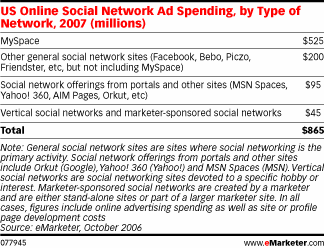
Social Network ad spending grows rapidly to $900M

Latest numbers tracked by eMarketer.com are showing that Marketing 2.0 is ramping up more rapidly than expected. This new 2007 Ad spending forecast, totaling $865M specifically in Social Networking ad, is far bigger than the last $280M estimate for 2006, still coming from eMarketer. This is pretty much in line with the 2010 forecasted $1.8 Billion.

This is to be compared with the overall $16.7 Billion spent on US online advertising for 2006 i.e. 1.7%, which is a relatively small chunk but growing fast.

"The underlying concept will influence the way advertising is done in all media, not just online." says Debra Aho Williamson, senior analyst and author of eMarketer's new report, Social Network Marketing: Carving Out Some MySpace.

Social Networking is definitely an important dimension in Marketing 2.0 and the way it impacts relationships between consumers or customers and brands.