Sunday, May 31, 2009

Enterprise 2.0 is coming: 30% of executives see social networking belonging to their business strategy


A recent research from Deloitte - see chart - gives us a clear signal that Enterprise 2.0 is making progress in our 2009 corporate world. As expected, this social transformation is coming from the people getting self-organized rather than from the top, as anticipated in the very good book Here Comes Everybody: The Power of Organizing Without Organizations.

As a matter of fact, 55% executives reveal that their company do not have an official policy for social networks. They'd better have one because it's easy to damage a company's reputation on social media as nearly 75% employees agrees.

There is also a risk for employees to expose their profile on social media as it can impact their reputation in their job context in a negative way. We need to address these privacy issues over time, but for now just beware to separate what your "friends" see from what the world can see.

Saturday, January 24, 2009

B2B Marketers’ Priorities and Pain Points for 2009


According to Marketing Sherpa new research, the previous one was conducted in Feb 2008, B2B marketers will focus on:
  1. Dealing with lengthening sales cycles
  2. Doing more with less
  3. Web 2.0 and social media marketing
  4. Focusing on lower-cost, high-impact lead gen tactics
I will obviously only highlight the point 2. which wouldn't have been on the list a few month ago. I remember being looked at as a strange animal when pitching about Marketing 2.0 back in 2007. I heard many things as "this is just a fad", "you're always trying to bring up something new", "Our customers are not 15 years old", etc.

In the marketing area, social media and Web 2.0 importance is raising under this economic downturn period we're in, more rapidly I anticipate than if the business was going to grow. I'm expecting Cloud Computing and new software subscription business models to come up more rapidly in the IT space for the exact same reason. The economic downturn is an incredible opportunity to reconsider what we've been doing so far, to challenge deeply our fundamentals, to stress decisions that were not that urgent otherwise. A good thing in my views though of course I suffer just as everyone out there of this downturn (mood downturn as well by the way).

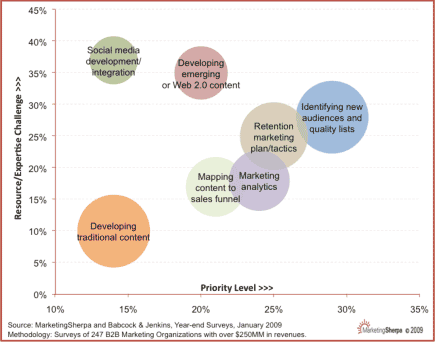
The research points out that many marketers still find Web 2.0 usage within their marketing campaigns arsenal a challenge. First and foremost because Web 2.0 is still new for a lot of them. They're not digital natives and tend to relate to the activities they're comfortable with (Webinars, White papers, etc.). Their top challenges, according to the research are:
  1. Social media development/integration
  2. Developing emerging Web 2.0 content, such as videos, blogs and podcasts
My take would be for you, already a blog reader ;-), to start your day in the office tomorrow by deciding to integrate in one of your planned campaigns a Marketing 2.0 technique. Try to pick the one that is intuitively the most relevant to your audience (start a blog or a podcast, foster a community or integrate an existing one, turn a major topic of interest into a wiki for and by your customers, start a twitter micro-blog for one of your offer) and do not forget about including video material as we discussed earlier this month.

I would also support this recommendation from Marketing Sherpa:
“Mapping content to the sales funnel “ is an immensely important aspect of success in lead nurturing for the complex sale. It deserves to be among the top priorities because some of the others – Web 2.0, social media and traditional content – are at their most effective when mapped to the sales cycle.
Marketing 2.0 will make it big in 2009.

Saturday, January 10, 2009

Video is even more Web 2.0 mainstream in 2009


According to Comscore, 77% of the US Internet audience viewed video online in November 2008 for a total of 12.7B videos viewed, growing 34% compared to 2007. Do you really consider your 2009 campaigns without it?
So, some numbers for you:
  • YouTube is is still on Top, representing 98% of all videos viewed on Google's sites.
  • The average online video viewer watched 273 minutes of video.
  • 97 million viewers watched 5.1 billion videos on YouTube.com (52.3 videos per viewer).
  • 52.5 million viewers watched 371 million videos on MySpace.com (7.1 videos per viewer).
  • The duration of the average online video was 3.1 minutes.
  • The duration of the average online video viewed at Hulu was 11.9 minutes, higher than any other video property in the top ten.
Web 2.0 is video intensive.

Friday, January 02, 2009

Happy New 2009 Year


I strongly believe that 2009 will be the opportunity for everyone to revisit everything they've been doing so far. Our values are changing, rules must follow thus giving birth to a better world.I wish you a very happy 2009 new year looking at the stars with a smile on your face.
Posted by Picasa

Tuesday, December 30, 2008

For the first time: the Web, 2nd to TV, surpasses all other media as News Source


I know most of you could perceive it naturally or because you're very much web centric (is this a sign of youth ;-), but I found it interesting to see it confirmed by research: the web is now the preferred source of information - whether national or international - for 40% of the researched compared to 24% in September 2007. Wow! That's a big wave in my opinion, a tipping point I should say. The noticeable progress is against Newspapers as you can see in the above diagram.

And for young people, 30 years old or less, the web rivals TV with a serious jump in 2008 - see the diagram below - indicating that TV is next to be surpassed in the coming years.

This is only good news for the Web 2.0 movement, it reinforces the importance of our web presence as individuals and as members of multiple communities.

Wednesday, December 24, 2008

Holiday season sales online down just 1% despite 5 days shopping missing vs 2007

According to ComScore, this online holiday season is impacted by 5 fewer shopping days this year compared to last year. The impact seems to be contained to 1% decrease. The increased average online spending per day between Thanksgiving and Christmas ($643M, up 5% from last year) does not compensated for 16% decreased number of shopping days for this period.
The e-commerce spending for the first 49 days - Nov through December 19 is totaling $24.03 billion. The top categories are Sport & Fitness (+31%), Books & Magazines (+18%), Video Games, Consoles & Accessories (+17%), Apparel & Accessories (15%), Flowers, Greetings & Gifts (+13%) while Music, Movies & Videos are down (-24%).

Friday, December 12, 2008

2009 IT Trends: can community based IT services on the cloud help?


As 2009 sets itself to unfold, major IT trends are starting to shape our future.
In a nutshell we should be watching:
It's going to be tough and only those who can go beyond their fears and control it will be able to seize opportunities in front of us. Yes IT will be impacted, but what is a better time to make the tough decisions you've been reluctant to make?
I found it very interesting that in this context the eTask.it initiative, referred to by a friend of mine part of the management team there. In a nutshell, they describe themselves as "the first IT collaborative system" addressing IT staffing via community enabled sourcing.
Cloud Computing can also deliver Service as a Service, kind of funny, or maybe more appropriately Service on the Cloud as an important part of the Cloud Computing trend.
Good luck to them. More than yesterday, lesser than tomorrow, bet on the Web 2.0 for your future.

Tuesday, October 07, 2008

Do you see the elephant?


You know I usually never discuss matters directly relating to the company I work for, but today I need to make an exception.
I was fortunate enough to participate to the public launch of Sage ERP X3 in Germany. Kudos to the team! Big milestone in our expansion, well prepared, executed with fun.
So here is why the exception: the German team decided to produce a funny video and I could not help but to share it with you.

Have fun! Share it, ERP marketing can be fun as well ;-)

I'm sure Christopher on the team would be happy to discuss about typical marketing 2.0 tactics.

Friday, October 03, 2008

What are the key forces driving to Enterprise 2.0 transformation?


Tectonic forces displacing enterprise applications boundaries are very diverse, I don’t pretend to be exhaustive here, but I’d like to highlight the ones having in my opinion a significant impact:

  • Ubiquitous good quality (bandwidth) web access – check broadband stats – encouraging employees mobility
  • Web crazy expansion (5.5M new users per week, 1.3B Internet users in Dec 2007) and more specifically mobile web expansion (3.2B mobile devices and among them 1.2B with a modern web browsing user experience) and explosive e-commerce growth - check IDC stats : 50% internet users will buy on line this year – favouring extended enterprise process development
  • Users are educated at home on web based applications, noticeably on web 2.0 applications (Social Networking, Blogs, Wikis, …) and are increasingly accepting the Cloud Computing model relevance by using it (personal e-mail, Instant messaging, social bookmarking, photo & video sharing, e-banking, ….) – preparing for webtop and web 2.0 introduction in the enterprise (check "moving from deskltop to webtop" post)
  • SOA and Mashup emergence as a distributed application architecture
  • Transactional processes automation maturity – very typical of the ERP supported ones – will privilege productivity gains and transaction costs reduction (referring to  Ronald Coase « The law of the firm ») in automating collaborative processes and exception management, paving the way to ERP/Web 2.0 integration

This nice cocktail augmented with a solid number of “ Y Generation ” employees -- born between 1982 and 1994 - having grown with the natural use of SMS, instant messaging and social networking on the Web and which will be enterprise leaders in the next ten years - prepares the company with its change towards Enterprise 2.0 (first defined by Andy McAfee) characterized by the use of the Web 2.0 collaborative applications within the enterprise to harness collective intelligence. 


Saturday, June 28, 2008

Mobile Web 2.0 revenues to reach $22.4B in 2013


Fellow Marketers, I know I've been busy like crazy since a while but let's believe that I'll be back here with more regularity.
I've been tracking Internet users growth since Scott McNealy, in one of his colorful keynote, reminded all of us that the Internet was still growing fast. Most of us in the western world do believe that Internet is a given but it's growing still fast - 5M new users per week - and growing mobile especially in Asia.


For us, marketers and software vendors, it must remain on our radar chart when we plan our campaigns and product roadmaps, especially when social networking is front stage. Why? Because more users on the net means more value for the network thus for the Internet, this is Bob Metcalfe law. It means more reach for any community every day.

If this is accurate, then Web 2.0 is going to bring a lot of revenue on the table, not only VC's, and Mobile Web 2.0 should as well. Juniper Research issued in May 2008 an interesting white paper stating that "Mobile Web 2.0 revenues to reach $22.4bn by 2013 driven by User Generated Content and Social Networking." Point taken and much appreciated.

Get ready for it. Web 2.0 burst year one i.e. 2007 was all about user generated content. Year 2 i.e. 2008 will be all about social networking and your multiple social networking identities management. More on this later, but you can double check Web 2.0 2008 conference keynotes that I did attend in San Francisco last April.

Saturday, March 15, 2008

Music, Video and Software business models paradigm shift underway


When did you last buy a CD? I didn't buy one for a pretty long time and the last one I bought was from an artist I like nearly every single piece of work he creates, Pat Metheny. Is then the music business going away for a free show? Of course not, because one buys legally music on-line. Do we really?

NPD Group, a market research firm, gave us some clues recently in publishing a new report about the music industry. Here are in shorts the finding for 2007:
  1. 48% of all teenagers never bought a CD (38% in 2006)
  2. CD sold in the U.S. fell 19% from 2006
  3. Apple iTunes (selling only digital downloads) is now the #2 music shop in the U.S. jumping ahead Best Buy and trailing Wal-Mart
  4. 29 Million people bought music legally from online music stores, up from 24 Million in 2006 i.e. + 21%
I'm convinced buying singles or albums on-line is not the ultimate business model. What about subscribing for a monthly fee of about $20 to listen to all the music you can get legally? Store it on your MP3 device when you're not connected for as long as you pay for your subscription?

You like this idea? All the music you can get for a flat fee? What about Video
And what about for FREE?

Well checkout hulu.com, all the video you can get on-line for free, because you get advertising with it. Unfortunately only in the U.S. for now.

... and what about software? What about a flat monthly fee to access a dedicated application portfolio coming out from several vendors, a bouquet of SaaS focusing on a business or personal matter (Sales, Marketing, ...).

Let's watch this e-commerce space carefully as music and videos are paving the way when it gets down to digital goods business models tsunamis.

Saturday, March 01, 2008

Where is Internet headed?


It's been a long time since I published a post. Very busy working in my new company to revamp the product portfolio and its marketing. It's a B2B software company and the question of course was: "what to have on our radar to think about the future releases of our applications".

My nickname in this new company is Emmanuel 2.0, you wonder why? That's because you're a newcomer to this blog. So here we are, trying to figure out the major Internet trends. I've always been fond of supporting my hunches with data. So let's deal with the claims first and the figures to follow.
Claim#1: The Internet is growing still very fast (5M new users per week) thus making e-commerce king
Claim#2: The Internet is growing mobile (2.8B mobile phones in 2007 growing to 3.8B in 2011 to be compared with 980M PCs in 2007 growing to 1.5B according to Gartner). "Worldwide sales of mobile phones to end-users surpassed 1,15bn units in 2007, a 16% increase from 2006 sales", Computing SA citing Gartner. And if you're wondering what is the major customer benefit iPhones brings (4M units sold in 2 quarters), here is my take: real and easy web browsing. I can at least speak for myself, I do not fire up my PC at home to navigate on the web and checkout my facebook page, I use my iPhone.
Claim#3: Web 2.0 is driving the webtop metaphor vs the desktop metaphor (check my post "from desktop to webtop" about it)

Now with the additional figure about e-commerce: "eMarketer predicts that online retailers in the US will ring up over $100 billion more in sales in 2012 than they did in 2007. Sales growth will come mainly from consumers who are shifting their spending from traditional retail stores to the Internet.", eMarketer. Take a look at the table for more details, but you can easily figure out that buying behavior and for that matter marketing web behavior are shifting big time. I would strongly advise to revise your marketing mix to accommodate at least 20-25% to web marketing including viral marketing techniques.

Finally, and I'm sure we'll agree easily, web content has also shifted to video and pictures. For this one, I'll let you find the figures. Let's rock marketing on the web for 2008 fellow marketeers.

Saturday, November 03, 2007

Software on tap: SaaS and ASP are really not the same


I launched MS Word today, it's 24 years old! Don't you have enough? Don't you think time has come for a new software paradigm. Do you like Word? What do you do in e-mail then? This industry has come to a conclusion that software could very well migrate to it's editor servers. It started with hosting, then ASP, and now SaaS (also called on demand applications) is coming around.
Conventional wisdom has coined it at the same thing but it's not. But an ASP delivers your monolithic application at distance, that's all it does. Those who believe ASP and SaaS are the same thing have just missed the Web 2.0 paradigm shift where the web has become an application platform. In fact "application" is not a proper term, where as "application services" better describes what is happening. You probably know Facebook by now. If you don't go ahead and build your friend community there. As I recently stated, one of the major success factor of facebook lies in its application platform strategy. The beauty of it is that users are defining a unique user interface to THEIR facebook by adding application to their home page. Customization, as we know it, is king. Gone the days when software vendors would define frozen user interfaces e.g. MS Word.
But this new way of combining small applications, or widgets, into a dedicated user customized portal has reached the enterprise. Yes! Enterprise mashups are coming up. Do you know Longjump? You don't, then just go there for a test drive. It speaks for itself far better than a long post of mine.
This is the destination: mixable enterprise widgets or applets on tap. You pay as you drink it. Software is a service, isn't it?
Bye bye MS Word and all the monolithic applications, whether on your PC, your servers or with your ASP. Time has come for SaaS to thrive.

Sunday, October 21, 2007

Technology's 10 Most Mortifying Moments


Just for fun, I could not resist but to share with you this article on Computer World Technology's 10 Most Mortifying Moments. You probably remember all of them, but even if you do you'll have a great laugh.
Let's just end the week like this. We'll be back on more serious topics next week like what is the difference between ASP and SaaS?
My favorite is still Ballmer dancing on stage. I wish I could be there to see people

Sunday, October 07, 2007

Social Networking: the facebook mashup effect


I'm a recent facebook user. I knew about facebook for quite a while but I thought, as probably most of you, that it was a youngster phenomena. I'm no longer a youngster if anyone in doubt out there ;-) . This comes as no surprise as Facebook was created in 2004 by Mark Zuckerberg, Harvard graduate, and restricted at first to Harvard College students, then to other Boston area schools. More details on Facebook history here. On May 24, 2007, Facebook launched an API that allows the development of applications to be used on the site, known as Facebook Platform. A defining moment that illustrated one more time this web 2.0 postulate that the web is now an application platform.

When inviting some of my friends to facebook, I sometime needs to explain to the most reluctant among them why this social network site is THE one. I think this ability to mashup tens if not hundreds of cool applications to leverage your friends network is sticky. It gives your facebook a constantly evolving face, a user interface typically webtop where users do refine it as they use it -- see We're moving from Desktop to Webtop. The real-time informations about your friends (mood, networks, events, ...) gives it another reason for it to be addictive. Some of them even joined a group called "I facebook too much" demonstrating the addiction.

As you can see in the Alexa graph, Facebook is on its way in 2007 to surpass the MySpace phenomena. More than the success of social networking as one of the Web 2.0 killing applications, I see it as a clear indication that mashups and webtop will prevail in the future. Fellow software vendors, take it as a home run. Enterprise 2.0 software should take this into account as well, as it will not remain a consumer phenomena. Large corporations do need social networking. In the coming months, we should see tremendous repositioning around this and some of the software vendors could just enter obsolescence allowing for a new software leaders generation. Beware!

Sunday, September 30, 2007

Blogging future: leverage the long tail opportunity


I've been spending an interesting afternoon at Apple Expo in Paris yesterday with my dear friend Christophe Ginisty. Beside being Apple's PR, he's also renowned for his blogging activity. He organized a debate about blogging future. Asking candid, or was it, questions about whether blogging is just a fading trend or a ramping up attitude.

I tried to make a point there that I wanted to share with you. Blogging is to press media what video sharing (YouTube, DailyMotion) is to TV, and Music sharing (MySpace) is to Records. Blogs success in my opinion lies in the ability for anyone to publish articles without a financial equation supporting it and with very low barriers to entry. Blogging is free and easy (no web design skills required), to be compared with the press where audience must be as large as possible for advertising revenue to enable it, and where printing or broadcasting requires technical and financial muscle. The same is true for video and music production and distribution compared to the new free or close to free e-capabilities.

Blogging, publishing music and video on the net doesn't require a large audience either to be possible. It is enough to have a few hundred interested people and you can keep going. But adding up these very diverse communities of interest leads to a massive audience. This is the long tail opportunity that the net offers. To be compared to Business 2.0 magazine not publishing anymore, despite facebook community trying to rescue, by economic failure.

So to me, all these individual contributions to the blogosphere, videosphere, photosphere and musicsphere are here to stay, widen and provide a huge creativity and freedom expression area without a capitalistic equation attached.

Sunday, September 23, 2007

2007 major Marketing 2.0 trends


We're entering our last quarter of the year and we should be stepping back, before the final rush for '07 revenue, to analyze this amazing year and its trends. Marketing, Business and the Web -- Web 2.0 flavored of course -- have never been more inter-weaved. This is why I called this Marketing 2.0 trends.
Let me give you my list, you'll be able to hammer me in a few month when reading back all of this:

1. Eco-responsible: we've been talking about it for months if not years, but I guess '07 is the milestone year for eco-responsible attitude in business as much as in our day-to-day life

2. Rise of e-commerce: we've discussed the numbers earlier this year here on Marketing 2.0, and there's no doubt e-commerce is no longer a fantasy but accounts for a significant part of the business either B2B or B2C. You cannot ignore it or consider it secondary.

3. Transparency: consumers demand relationships with brands mirroring the relationships they have in the real world and above all they demand transparency. Whether they'll get this transparency from the brand directly or relying on user generated content to elaborate it, they'll get it. If it's the latter, your brand is in trouble. Remember: you don't want to get Dell'd.

4. Community consumption: no longer do consumers rely on the press and vendors to choose. They increasingly rely on community advices for guidance. It is your job to influence communities, transparently please, as well as build your own communities.

5. Intangible real value: on top of it, we do buy virtual products and services for real money. Did you notice how many e-economy firms got the highest market caps? This goes generally with a positive buzz vortex on the web. You can no longer ignore your brand e-attributes and pay attention to e-competition.

6. Meconomy: as the Time magazine cover once highlighted in designating the man of the year as "YOU", consumers are focused on 'me, myself and I'. Personalization, customization, customer centric are a must to succeed. And they'll be asking this question: "what makes me happy?". Yes, happiness has become a valued because increasingly out of sight.

7. Open for global business: there are no boundaries to memory anymore. You act local? We take it global. No one can anymore think its business strategy in isolation. The fast growing emerging economies (China, India, Brazil to name a few) unleashing new buying patterns and new global brands (Lenovo, Mittal, ...) are already changing your plans. You'll be selling there or be sold.

My fellow marketers, what a thrilling world! Feel free to comment and contribute, we'll be looking at this for the next few months.

Saturday, September 15, 2007

Customer equity to drive your marketing ROI


During my Lotus years, I've been given the opportunity to meet Mike Zisman our CEO at the time. One of his statement stayed with me since then: "The purpose of any enterprise is to acquire new customers and retain existing ones. Product an services are only a means to that end." It sounded a bit simplistic initially, but my experience in several companies since then reinforced my conviction of the importance and truthfulness of this statement.

During my marketing journey, I discovered the notion of customer lifetime value (CLV), more complex to comprehend and so effective to coin what your marketing focus should be and furthermore how to present it to your team. It also allows to present to CEOs and shareholders the real value ($) of customer loyalty.

Here comes customer equity that definitely coins the term that best represent all of this. You now can think of CLV as an an additional equity to the shareholders or the brand ones.What if you could revise Marketing ROI and fine tune your marketing course of actions based on this equation coming from Roland T. Rust in Advertising Age : "The ROI is simply calculated as the projected increase in customer equity minus the discounted [marketing] investment divided by the investment."

But how do you calculate customer equity with real numbers? Now we're talking ;-)
Well, a number of tangible and intangible enters into this and I do not necessary agree with Roland Trust in his article. I'd refer you to Customer Equity Calculations dedicated site, and will come back on this later on. To approach it, just think of customer equity as the total of the discounted lifetime value of all of its customers. I know, not that intuitive.


To be continued ...

Sunday, September 02, 2007

Enterprise 2.0 is here to stay


Fellow marketers, I've been away for quite some time, focusing on some quality time without a computer (can you believe that?). I'm back, energized and ready to roll!

I wanted to open it up to a new topic, here on Marketing 2.0, that is keeping my team busy for quite some time now: Enterprise 2.0.

I'm sure you heard the buzz word before and maybe took a more in depth look at it. But I guess for those working in the IT industry and already involved in the Web 2.0 phenomena it's the natural question to ask ourselves: what are the Web 2.0 attributes, social behaviors and underpinning technologies bringing to the enterprise? Is this only about taking blogs, wikis, RSS feeds and what have you, to your intranet? Or is it a more profound paradigm shift that will finally unleash the expected new enterprise species of the new millennium?

You bet some of our gurus have been writing and pitching about it as the yearly Enterprise 2.0 conference can attest. Let's hear some of the most visible. First of all, spend about 10mn to view this introductory video on ZDNet Web 2.0 for the enterprise.
You can then take the direct and simple view of Andrew McAfee's Enterprise 2.0 definition:
"Enterprise 2.0 is the use of emergent social software platforms within companies, or between companies and their partners or customers."
Of course what Andrew develops beyond that definition is more complex but is basically centered around a new stage in knowledge management. But I am more in sync with Don Tapscott's views about it. If you did not read at least one of Don's best sellers, I encourage to start with Wikinomics. To give you a feel for it:
"The rise of pervasive, networked IT is fostering new business strategies and designs that enable firms to create differentiated value, lower cost structures and therefore increase their competitive advantage. A new model of the firm is emerging – the Enterprise 2.0. Firms that embrace this model succeed and compete well. Those that do not decline."
If you're now thrilled and ready to spend 40mn or so, listen to Don's pitch at the Enteprise 2.0 conference. It's fun and enlightening.
Finally, and to close this first post about Enterprise 2.0, I found Fred Cavazza's in depth post What is Enterprise 2.0? about it very useful to provide a solid 360 view.
Stay tuned for more, Enterprise 2.0 is here to stay.